Pride, Japan, and a Pair of Shoes: Spectrum / Story
A few days ago in Japan, I spotted a pair of shoes that I immediately liked.
Bold colors. Fun design. Retro energy. Vacation shoes.
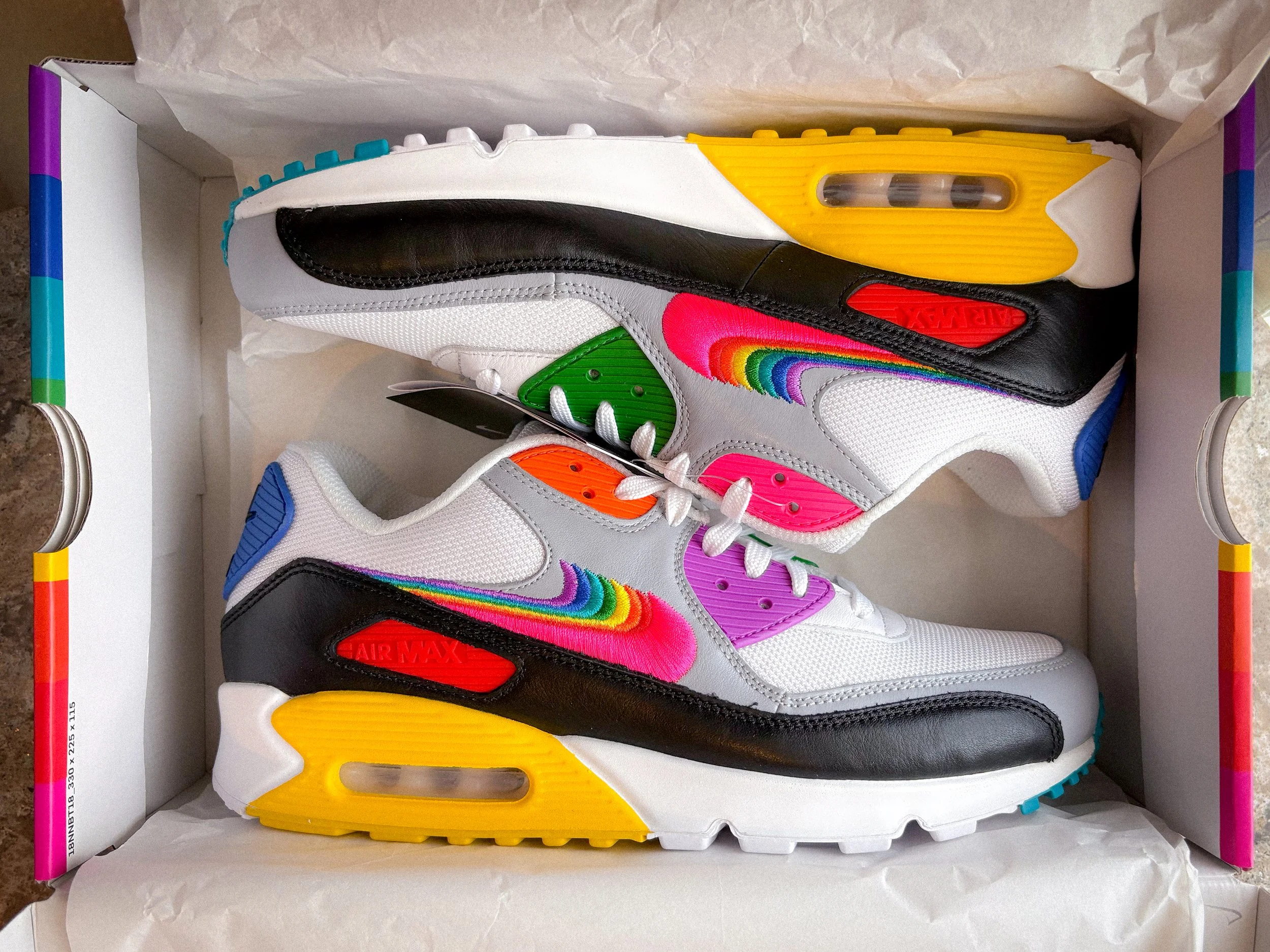
I picked them up, looked them over, and noticed the only size they had available happened to be my size - assuredly a sign that I should buy them 😜 (this was a resale shop and these are a 2019 release so stock was very limited).
Only after telling the shop owner, “I’ll take ‘em!” did I notice the “Be True” branding and realized they were part of Nike’s Pride collection.
And honestly, I had a brief, internal… moment.
Not because I suddenly disliked the shoes, but because I found myself suddenly confronting how quickly modern symbols come preloaded with assumptions, reactions, and cultural baggage. Before we even think for ourselves, we often feel pressure to align with a specific side of what something means… and what that “meaning” says about us if we wear it, display it, or appreciate it.
But instead of immediately deciding what the shoes meant, or what I was supposed to think about them, I let myself stay curious.
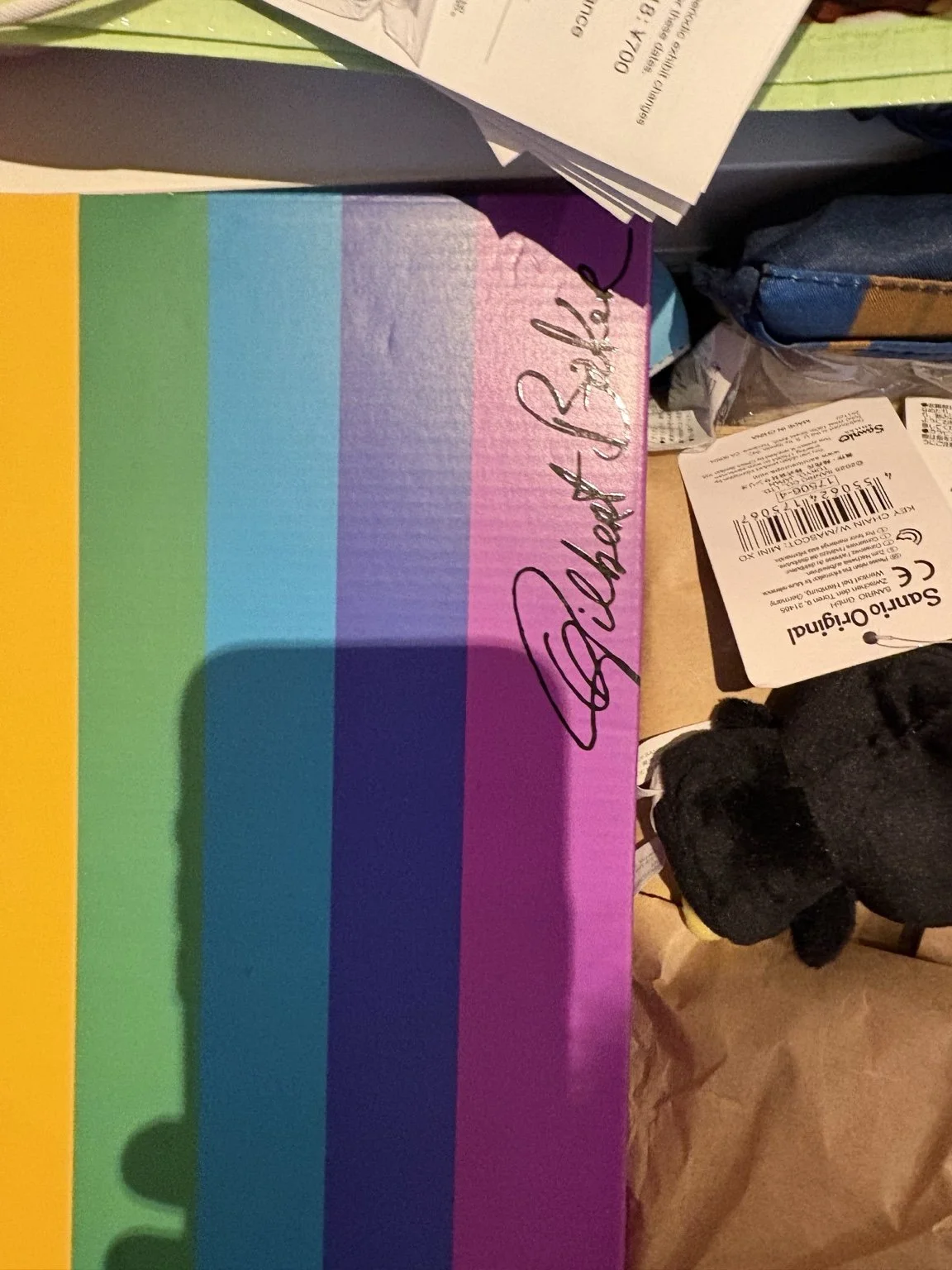
The actual photo I took of the box to research the signature which, at the time, belonged to a person whose name I didn’t even recognize.
What interested me wasn’t whether I should still like the shoes. I already knew I did. What interested me was how and why a symbol can get distilled into something that immediately evokes such different reactions from different people.
That curiosity led me into the history of the original rainbow flag designed by Gilbert Baker in 1978. And what surprised me most was how broad, poetic, and deeply human the original vision actually was.
Each color originally carried its own meaning.
Hot Pink for Sexuality
This one tends to get the most attention now because of modern conversations around sexuality and identity, but originally it was less clinical or political and more about desire, intimacy, attraction, human connection, and life force.
In a broader sense, it represented the idea that sexuality is a natural and meaningful part of being human, not something shameful or hidden.
Red for Life
This one is wonderfully universal.
Red represented blood, vitality, survival, energy, passion, and the sheer force of being alive.
It’s probably the least controversial and most instinctive color meaning in the whole flag.
You could argue almost every culture associates red with life force in some way.
Orange for Healing
This is one of the most emotionally interesting colors to me.
Healing implies restoration, compassion, recovery, care, and reconciliation.
And in the late 70s context, this was before the AIDS crisis fully unfolded — which later gave the idea of healing even more emotional weight in LGBTQ communities.
But again, the concept itself is universal.
Everyone needs healing.
Yellow for Sunlight
This one feels almost childlike in its optimism.
Yellow represented warmth, visibility, hope, joy, illumination, and openness.
Not “spotlight” in a performative sense, but more: life lived openly in the light.
There’s something deeply anti-shame about that symbolism.
Green for Nature
Baker talked about the rainbow as a natural phenomenon, which made green especially important.
Green symbolized the earth, growth, renewal, belonging within creation, and harmony with the natural world
This is one reason the flag originally had a surprisingly organic/spiritual tone rather than purely political energy.
Turquoise for Magic and Art
This is probably the most fascinating stripe because it feels the least modern and the most mystical.
Turquoise represented creativity, imagination, artistic expression, mystery, and transformation.
“Magic” here wasn’t literal sorcery so much as the transcendent quality of art, beauty, and human creativity.
Indigo for Serenity
Indigo represented peace, balance, emotional calm, inner centeredness, and coexistence.
Again, not exactly the emotional tone of modern internet discourse. 😅
Which is part of why revisiting these meanings feels so striking now.
The symbolism was deeply aspirational.
Violet for Spirit
This may be the most profound stripe of all.
Violet represented soul, human spirit, meaning, transcendence, and interconnectedness.
And importantly: not necessarily religion.
More like the recognition that humans are not merely physical or political beings.
There’s a philosophical/spiritual dimension to existence.
Overall, that’s a pretty sweeping vision for a flag that many people today interpret only through contemporary political lenses.
Very interestingly to me, two of the original colors—hot pink and turquoise—were eventually dropped, not because their meanings disappeared, but due to the realities of fabric availability, mass manufacturing, and public display. There’s something oddly human about that to me: even symbols created as artistic expressions for massive movements still get shaped by practical constraints.
And maybe this says something revealing about my own brain, but reading through the meanings activated the exact same part of me that has always loved collecting things, completing sets, and mentally organizing systems. Seeing those words and colors lined up on the inner sole of the shoe felt weirdly nostalgic—like watching Captain Planet’s Planeteers call out their powers one by one all over again.
Sexuality
Life
Healing
Sunlight
Nature
Magic
Serenity
Spirit
It felt less like encountering a political slogan and more like stumbling onto an alluringly earnest little catalog of human aspirations.
Not exactly the emotional vocabulary of modern internet discourse.
The more I read, the more I realized the original rainbow carried political significance, but its symbolism was broader and more aspirational than I had expected. It was imagined as something expansive—a symbol of the full spectrum of human experience and dignity.
And honestly, part of what made me a little sad was realizing how often the symbol now gets reduced almost entirely to conversations about sexuality alone.
To be clear, sexuality was absolutely part of Baker’s original design. One of the original colors represented it explicitly. And I understand why the rainbow became deeply connected to LGBTQ visibility, identity, and solidarity over time. That history matters.
But the original vision also seemed to reach far beyond any single category of person or experience. It included ideas every human being understands and longs for: healing, peace, creativity, nature, joy, spirit, life itself.
In that sense, the rainbow feels less like a symbol meant to divide humanity into groups and more like a reminder that human beings are complex, layered, and connected in ways that transcend the categories we often sort ourselves into.
What stayed with me wasn't a desire to redefine the symbol. It was the realization that I, like so many, had unknowingly reduced it. I had assumed I already understood what it meant, only to discover layers of history, symbolism, and human aspiration that I'd never taken the time to explore.
The more I sat with that realization, the more familiar it felt.
For most of my professional life, I've worked in documentary filmmaking and community-building. Again and again, I've watched what happens when people move beyond labels, assumptions, and headlines long enough to hear someone's actual story.
I've often shared a quote that has guided much of my work:
"There isn't anyone you couldn't love once you've heard their story.” —Mary Lou Kownacki.
Stories have a way of disrupting certainty. They complicate our assumptions. They reveal details that don't fit neatly into the categories we've created.
In some small way, that's exactly what happened with these shoes.
I thought I was exploring a symbol. What I was really discovering was a story.
The story of how a symbol evolves as it passes through different people, different moments, and different generations.
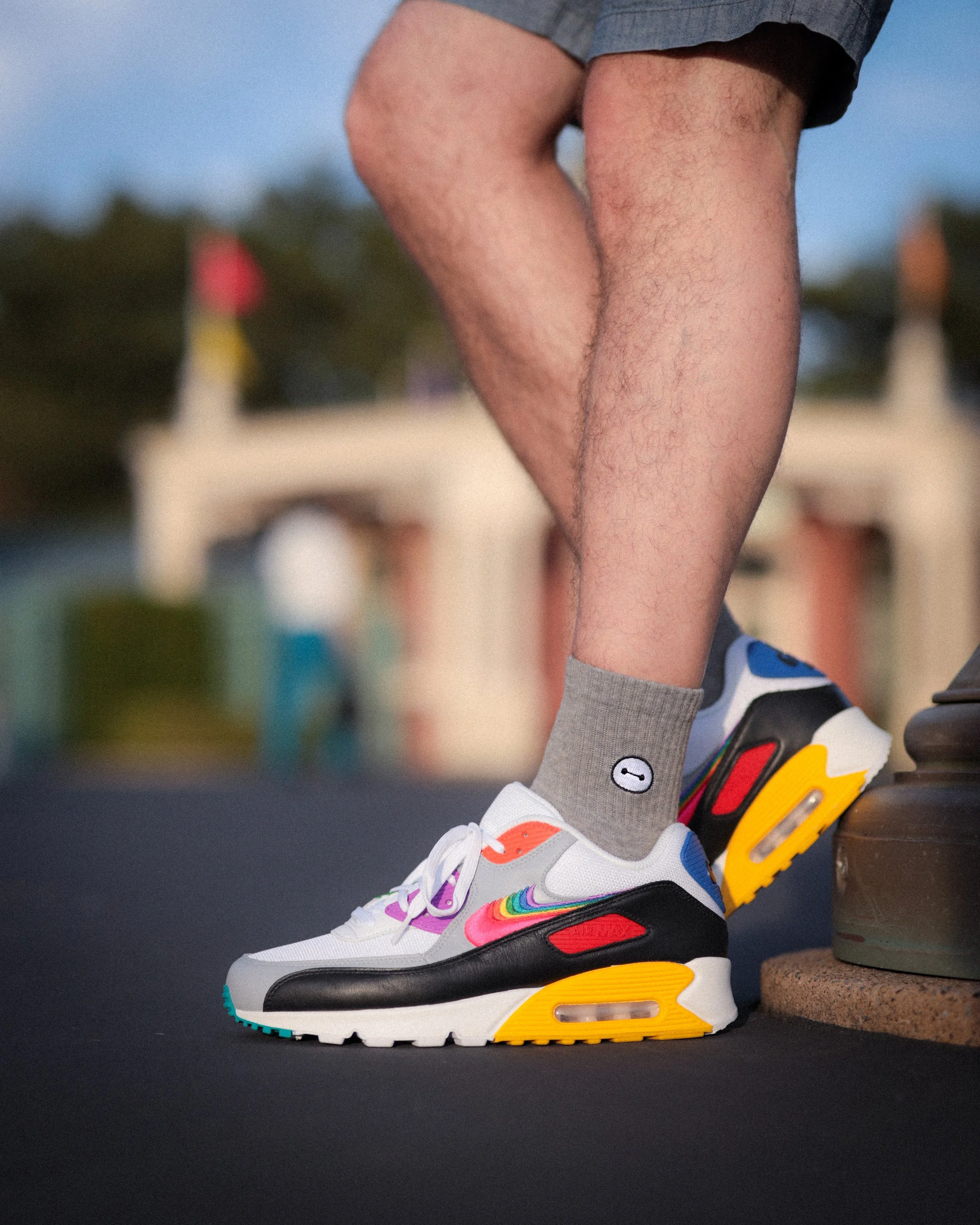
Me, rocking my brand new kicks at Tokyo Disneyland. Peep those awesome Baymax socks, too!
And as often happens when we take the time to hear a story, I walked away with a deeper understanding than the one I started with.
I was reminded, once again, of how often we’re all tempted to reduce a deeper story into a single interpretation.
Sometimes that interpretation is political.
Sometimes it's religious.
Sometimes it's personal.
Sometimes it's ideological.
But once we become convinced a symbol means only one thing, we often stop exploring what else it might be trying to say.
And to be fair, that flattening happens everywhere.
Religious symbols.
National flags.
Political language.
Even words like freedom, love, masculinity, feminism, patriotism, or diversity.
Eventually, complexity gets traded for immediacy.
In fact, this experience left me realizing that I've only scratched the surface. As Pride Month begins, I've committed to reading Gilbert Baker's memoir, Rainbow Warrior: My Life in Color, to better understand the person behind the flag and the vision that inspired it.
Not because I expect to agree with every conclusion or share every perspective, but because I've come to believe that understanding is rarely harmed by learning more.
If you're someone who already feels deeply connected to the rainbow flag, perhaps Baker's story offers an opportunity to revisit its origins. And if you're someone who has mostly viewed the symbol from a distance—or perhaps through the lens of politics, religion, or cultural debate—his story might reveal dimensions of it you've never considered before.
Either way, there seems to be value in hearing directly from the person who imagined it in the first place.
It also made me reflect on how differently I may have experienced those shoes if I'd encountered them somewhere else. Being in Japan—outside my familiarity with America's cultural sorting systems—perhaps gave me just enough distance to appreciate them first as design, expression, and color before immediately translating them into ideology.
And maybe that's part of what stayed with me most:
I could have missed an interesting and meaningful exploration if I had assumed I already knew what the symbol meant.
Curiosity didn't require me to abandon discernment, conviction, or personal beliefs. It simply asked me to resist the urge to collapse something complicated into something simplistic.
That feels increasingly important right now.
Because while judgment can create fast certainty, curiosity often creates unexpected humanity.
And in a world that constantly pressures us to sort people, symbols, and ideas into neat categories as quickly as possible, there may still be something valuable about slowing down long enough to ask:
"What else might this mean?"
Next Steps:
🧠 Think about it - When you see a symbol, word, or even a person that carries a potential for polarization, how do you react? In what ways could you approach with more curiosity?
💬 Talk about it - Have you read Gilbert Baker’s story? If you haven’t, would you consider reading it this month and sharing your thoughts?
👉 Sign up for the email list to get each new Juxtapost in your inbox. Don’t let the algorithms decide whether or not you’ll see the next one.